

Middle East

Europe


Oceania


Americas


INSIGHT
Extending the K-Beauty Experience Beyond the Event Venue
- 2026.08.31

OLIVE YOUNG FESTA LA 2026 × Moxy Digital
What if the brand experience that begins inside an event could extend beyond the venue and become part of the city itself?
In August 2026, OLIVE YOUNG brought its first OLIVE YOUNG FESTA LA 2026 to the United States.
Held at the Los Angeles Convention Center from August 14–16, the festival brought together 55 K-Beauty and lifestyle brands for an immersive showcase of Korean beauty and culture.
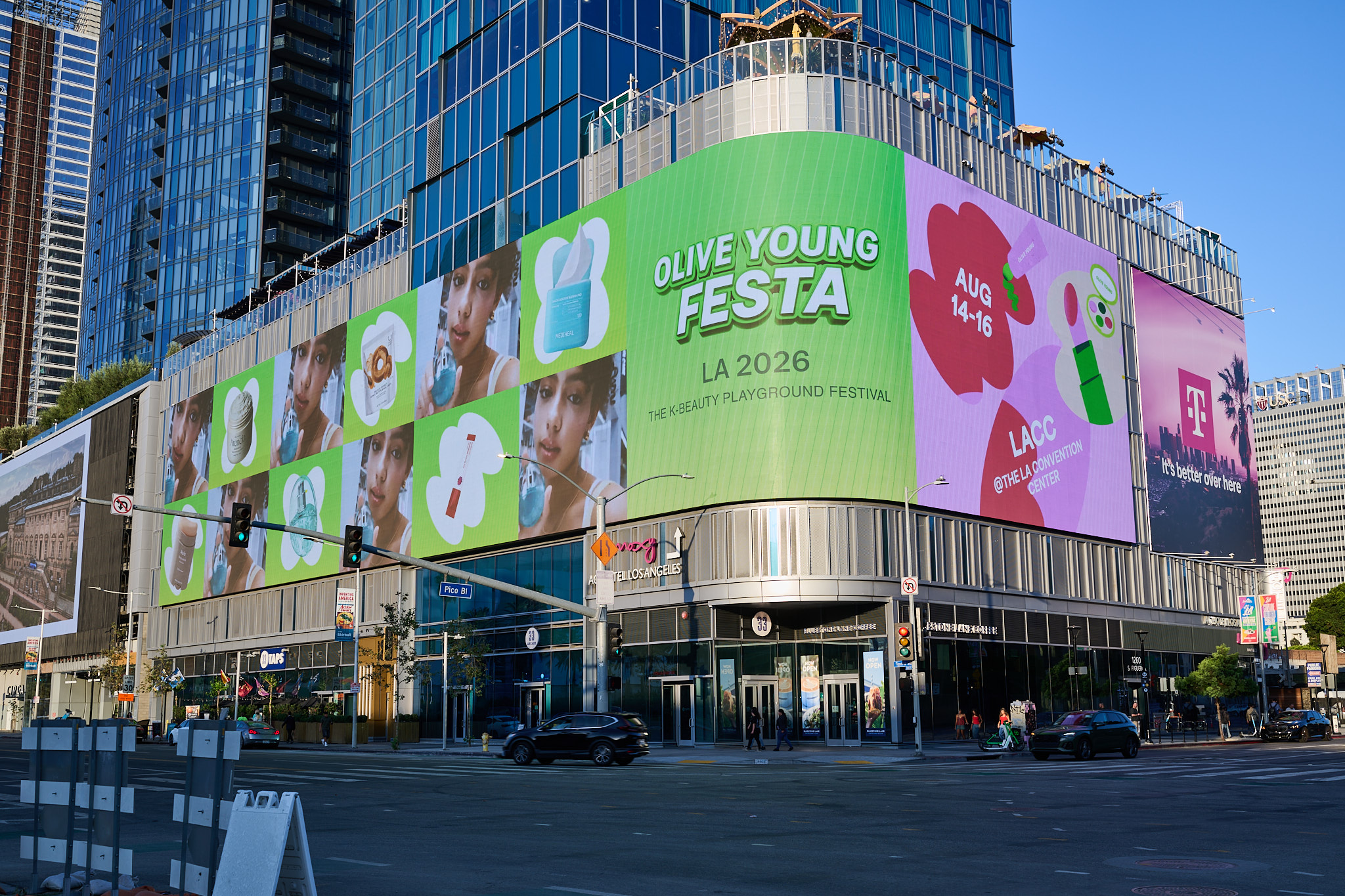
At the same time, the visual identity of OLIVE YOUNG FESTA appeared on a large-format digital screen in Downtown Los Angeles: Moxy Digital.
What makes this case interesting is not simply that OLIVE YOUNG used a large digital billboard in LA.
It is the way the OOH placement can be viewed as an extension of the K-Beauty event experience into the surrounding city environment.

Reaching Consumers Before They Enter the Event
Moxy Digital is located at the corner of South Figueroa Street and West Pico Boulevard.
The screen is an approximately 15,000-square-foot continuous LED video wall that wraps around the building, facing the surrounding streets and positioned near the Los Angeles Convention Center, L.A. LIVE, and Crypto.com Arena.
This location is strategically interesting because of its proximity to the Convention Center.
The Los Angeles Convention Center hosts approximately 200 events each year and attracts more than 2 million visitors annually.
As a result, this is not simply a large digital screen placed in a busy downtown environment.
It is a media touchpoint positioned within an event-driven urban ecosystem.
Since OLIVE YOUNG FESTA itself took place at the Los Angeles Convention Center, the placement can be interpreted as a strategic choice to extend the event’s physical presence into the surrounding streets.
Where K-Beauty Meets K-Culture
Another important element of this campaign is the timing and cultural context surrounding the event.
OLIVE YOUNG FESTA LA 2026 took place during the same weekend as KCON LA 2026, which was also held around the Los Angeles Convention Center and Crypto.com Arena.
KCON LA brings together K-Pop alongside Korean food, beauty, lifestyle, and other elements of Korean culture.
Meanwhile, OLIVE YOUNG FESTA brought together 55 Korean beauty and lifestyle brands.
This created an environment where K-Culture and K-Beauty were naturally concentrated within the same urban area.
CJ reported that the inaugural OLIVE YOUNG FESTA in the U.S. attracted approximately 100,000 visitors over three days.
This figure represents the scale of the event itself, rather than the reach or performance of the OOH campaign.
However, it provides important context for understanding the environment in which the OOH was placed.
The combination of a major K-Culture event, a K-Beauty festival, and a large-format digital screen near the venue creates a particularly relevant media context.
From an OOH perspective, this can be interpreted as placing the brand within a city environment where interest in Korean culture was already highly concentrated.
Bringing K-Beauty Into the LA Cityscape
Los Angeles is also a significant global tourism and entertainment market.
According to Discover Los Angeles, the city welcomed approximately 49.5 million visitors in 2025, generating around $42.6 billion in visitor-related business sales.
For a K-Beauty brand entering or expanding within the U.S. market, this kind of environment creates an opportunity to communicate beyond an existing Korean consumer base.
And OOH plays a particularly useful role here.
A digital billboard does not require the audience to already know the brand.
A passerby can encounter the brand through color, imagery, products, models, and recognizable visual codes before ever interacting with it online or inside a retail environment.
That makes large-format OOH particularly relevant for brands that are building cultural awareness in a new market.
In OOH, Instant Recognition Matters
The OLIVE YOUNG FESTA creative is built around a strong green visual identity, combined with product imagery, beauty visuals, models, and the event branding.
Rather than presenting detailed product information, the creative emphasizes visual recognition.
The viewer can quickly pick up several elements:
OLIVE YOUNG → K-Beauty → Products → FESTA
This is particularly important in an OOH environment.
People passing a screen on foot or in a vehicle may only have a few seconds to process the creative.
Long explanations are therefore less important than creating a visual hierarchy that can communicate the brand and context immediately.
The use of strong color, large-scale imagery, and concise messaging can be interpreted as an approach designed to maximize recognition within a fast-moving urban environment.
A Curved Screen Creates More Than a Bigger Billboard
One of the most distinctive characteristics of Moxy Digital is its physical form.
The LED wraps around the corner of the building, creating a continuous visual surface rather than a conventional flat billboard.
The approximately 15,000-square-foot display extends along Figueroa Street and reaches roughly 50 feet in height.
This changes the creative challenge.
The question is no longer simply:
“How do we make the advertisement large enough?”
Instead, it becomes:
“How can we use the architecture itself as part of the creative?”
The OLIVE YOUNG creative uses the broad surface to connect brand colors, products, models, and event messaging across the building.
As a result, the advertisement can be experienced less like a single billboard and more like a large-scale K-Beauty stage within the city.
This is one of the distinctive advantages of large-format DOOH: the medium itself can become part of the visual experience.
Extending the Event Experience Into the City
From an OOH strategy perspective, the role of this type of media can be viewed across three stages.
Before the Event
The OOH can serve as an early brand touchpoint for people traveling through the area, creating awareness of the event before they arrive.
During the Event
Visitors experiencing K-Beauty inside the Convention Center can encounter the same visual identity again in the surrounding city environment.
After the Event
The event experience does not necessarily end when visitors leave the venue.
Seeing the same brand identity again on a large urban screen can create another physical brand touchpoint.
The actual campaign objective has not been publicly confirmed, so these should not be interpreted as definitive campaign intentions.
However, considering the physical proximity between the OOH placement and the event venue, the campaign can reasonably be interpreted as an example of extending an event experience beyond the boundaries of the venue.
OOH Can Turn an Event Into a Citywide Touchpoint
This is where the case becomes particularly relevant for marketers.
A conventional event marketing model might look like:
Event → Audience
Adding OOH can expand that journey:
City → OOH → Event → Experience
Consumers may encounter the brand while moving through the city, arrive at the event with prior visual familiarity, experience the brand inside the venue, and then continue encountering the brand outside the event.
This approach can be particularly relevant for large-scale events such as:
- Festivals
- Conventions
- Concerts
- Sporting events
- Pop-up experiences
- Cultural events
Rather than planning media around the venue alone, marketers can consider the urban ecosystem surrounding the venue.
Marketer's Insight
Don't Plan OOH Around the Venue Alone
When planning OOH for a global event, one of the first questions should not simply be:
“Where is the event?”
A more strategic question is:
“Where do people move before and after the event?”
Then ask:
“Which locations along that journey have the strongest visual and cultural presence?”
In this case, the combination of the Los Angeles Convention Center, Moxy Digital, and a major K-Culture event weekend provides a strong example of how these elements can intersect.
The Convention Center attracts more than 2 million visitors annually, while the inaugural OLIVE YOUNG FESTA itself attracted approximately 100,000 visitors over three days.
Again, these figures should not be treated as OOH campaign impressions.
Instead, they help illustrate the scale and relevance of the surrounding event ecosystem.
From Event to City
OLIVE YOUNG FESTA LA 2026 introduced K-Beauty through a physical festival experience in Los Angeles.
Moxy Digital provided another opportunity to bring that experience beyond the venue and into the surrounding cityscape.
The strategic value of this type of OOH is therefore not simply about putting a brand on a large screen.
It is about connecting:
the event,
the audience journey,
the city,
the cultural context,
and the brand experience.
For K-Beauty brands, this approach can be particularly meaningful.
As K-Beauty increasingly becomes part of the broader global conversation around Korean culture, OOH can help transform that cultural relevance into a physical presence within the city itself.
Ultimately, effective event OOH is not always about advertising the venue.
It is about making the city around the event part of the brand experience.
OLIVE YOUNG FESTA LA 2026 × Moxy Digital
What if the brand experience that begins inside an event could extend beyond the venue and become part of the city itself?
In August 2026, OLIVE YOUNG brought its first OLIVE YOUNG FESTA LA 2026 to the United States.
Held at the Los Angeles Convention Center from August 14–16, the festival brought together 55 K-Beauty and lifestyle brands for an immersive showcase of Korean beauty and culture.
At the same time, the visual identity of OLIVE YOUNG FESTA appeared on a large-format digital screen in Downtown Los Angeles: Moxy Digital.
What makes this case interesting is not simply that OLIVE YOUNG used a large digital billboard in LA.
It is the way the OOH placement can be viewed as an extension of the K-Beauty event experience into the surrounding city environment.
Reaching Consumers Before They Enter the Event
Moxy Digital is located at the corner of South Figueroa Street and West Pico Boulevard.
The screen is an approximately 15,000-square-foot continuous LED video wall that wraps around the building, facing the surrounding streets and positioned near the Los Angeles Convention Center, L.A. LIVE, and Crypto.com Arena.
This location is strategically interesting because of its proximity to the Convention Center.
The Los Angeles Convention Center hosts approximately 200 events each year and attracts more than 2 million visitors annually.
As a result, this is not simply a large digital screen placed in a busy downtown environment.
It is a media touchpoint positioned within an event-driven urban ecosystem.
Since OLIVE YOUNG FESTA itself took place at the Los Angeles Convention Center, the placement can be interpreted as a strategic choice to extend the event’s physical presence into the surrounding streets.
Where K-Beauty Meets K-Culture
Another important element of this campaign is the timing and cultural context surrounding the event.
OLIVE YOUNG FESTA LA 2026 took place during the same weekend as KCON LA 2026, which was also held around the Los Angeles Convention Center and Crypto.com Arena.
KCON LA brings together K-Pop alongside Korean food, beauty, lifestyle, and other elements of Korean culture.
Meanwhile, OLIVE YOUNG FESTA brought together 55 Korean beauty and lifestyle brands.
This created an environment where K-Culture and K-Beauty were naturally concentrated within the same urban area.
CJ reported that the inaugural OLIVE YOUNG FESTA in the U.S. attracted approximately 100,000 visitors over three days.
This figure represents the scale of the event itself, rather than the reach or performance of the OOH campaign.
However, it provides important context for understanding the environment in which the OOH was placed.
The combination of a major K-Culture event, a K-Beauty festival, and a large-format digital screen near the venue creates a particularly relevant media context.
From an OOH perspective, this can be interpreted as placing the brand within a city environment where interest in Korean culture was already highly concentrated.
Bringing K-Beauty Into the LA Cityscape
Los Angeles is also a significant global tourism and entertainment market.
According to Discover Los Angeles, the city welcomed approximately 49.5 million visitors in 2025, generating around $42.6 billion in visitor-related business sales.
For a K-Beauty brand entering or expanding within the U.S. market, this kind of environment creates an opportunity to communicate beyond an existing Korean consumer base.
And OOH plays a particularly useful role here.
A digital billboard does not require the audience to already know the brand.
A passerby can encounter the brand through color, imagery, products, models, and recognizable visual codes before ever interacting with it online or inside a retail environment.
That makes large-format OOH particularly relevant for brands that are building cultural awareness in a new market.
In OOH, Instant Recognition Matters
The OLIVE YOUNG FESTA creative is built around a strong green visual identity, combined with product imagery, beauty visuals, models, and the event branding.
Rather than presenting detailed product information, the creative emphasizes visual recognition.
The viewer can quickly pick up several elements:
OLIVE YOUNG → K-Beauty → Products → FESTA
This is particularly important in an OOH environment.
People passing a screen on foot or in a vehicle may only have a few seconds to process the creative.
Long explanations are therefore less important than creating a visual hierarchy that can communicate the brand and context immediately.
The use of strong color, large-scale imagery, and concise messaging can be interpreted as an approach designed to maximize recognition within a fast-moving urban environment.
A Curved Screen Creates More Than a Bigger Billboard
One of the most distinctive characteristics of Moxy Digital is its physical form.
The LED wraps around the corner of the building, creating a continuous visual surface rather than a conventional flat billboard.
The approximately 15,000-square-foot display extends along Figueroa Street and reaches roughly 50 feet in height.
This changes the creative challenge.
The question is no longer simply:
“How do we make the advertisement large enough?”
Instead, it becomes:
“How can we use the architecture itself as part of the creative?”
The OLIVE YOUNG creative uses the broad surface to connect brand colors, products, models, and event messaging across the building.
As a result, the advertisement can be experienced less like a single billboard and more like a large-scale K-Beauty stage within the city.
This is one of the distinctive advantages of large-format DOOH: the medium itself can become part of the visual experience.
Extending the Event Experience Into the City
From an OOH strategy perspective, the role of this type of media can be viewed across three stages.
Before the Event
The OOH can serve as an early brand touchpoint for people traveling through the area, creating awareness of the event before they arrive.
During the Event
Visitors experiencing K-Beauty inside the Convention Center can encounter the same visual identity again in the surrounding city environment.
After the Event
The event experience does not necessarily end when visitors leave the venue.
Seeing the same brand identity again on a large urban screen can create another physical brand touchpoint.
The actual campaign objective has not been publicly confirmed, so these should not be interpreted as definitive campaign intentions.
However, considering the physical proximity between the OOH placement and the event venue, the campaign can reasonably be interpreted as an example of extending an event experience beyond the boundaries of the venue.
OOH Can Turn an Event Into a Citywide Touchpoint
This is where the case becomes particularly relevant for marketers.
A conventional event marketing model might look like:
Event → Audience
Adding OOH can expand that journey:
City → OOH → Event → Experience
Consumers may encounter the brand while moving through the city, arrive at the event with prior visual familiarity, experience the brand inside the venue, and then continue encountering the brand outside the event.
This approach can be particularly relevant for large-scale events such as:
- Festivals
- Conventions
- Concerts
- Sporting events
- Pop-up experiences
- Cultural events
Rather than planning media around the venue alone, marketers can consider the urban ecosystem surrounding the venue.
Marketer's Insight
Don't Plan OOH Around the Venue Alone
When planning OOH for a global event, one of the first questions should not simply be:
“Where is the event?”
A more strategic question is:
“Where do people move before and after the event?”
Then ask:
“Which locations along that journey have the strongest visual and cultural presence?”
In this case, the combination of the Los Angeles Convention Center, Moxy Digital, and a major K-Culture event weekend provides a strong example of how these elements can intersect.
The Convention Center attracts more than 2 million visitors annually, while the inaugural OLIVE YOUNG FESTA itself attracted approximately 100,000 visitors over three days.
Again, these figures should not be treated as OOH campaign impressions.
Instead, they help illustrate the scale and relevance of the surrounding event ecosystem.
From Event to City
OLIVE YOUNG FESTA LA 2026 introduced K-Beauty through a physical festival experience in Los Angeles.
Moxy Digital provided another opportunity to bring that experience beyond the venue and into the surrounding cityscape.
The strategic value of this type of OOH is therefore not simply about putting a brand on a large screen.
It is about connecting:
the event,
the audience journey,
the city,
the cultural context,
and the brand experience.
For K-Beauty brands, this approach can be particularly meaningful.
As K-Beauty increasingly becomes part of the broader global conversation around Korean culture, OOH can help transform that cultural relevance into a physical presence within the city itself.
Ultimately, effective event OOH is not always about advertising the venue.
It is about making the city around the event part of the brand experience.