

Middle East

Europe


Oceania


Americas


INSIGHT
Why Do K-POP Fandoms Choose Times Square for OOH?
- 2026.08.31

A Global Stage Created by Fans — PLAVE in New York’s Times Square
Times Square has long been one of the world’s most recognizable OOH destinations, where global brands, entertainment properties, and cultural content compete for attention across massive digital screens.
But the PLAVE case offers a different perspective.
Here, the billboard is not simply a medium for delivering an advertising message. It becomes a stage created by fans for the artist they love.

Times Square Is More Than a Billboard — It Is a Global Stage
Times Square is one of Manhattan’s most prominent commercial and cultural districts, connecting entertainment, tourism, retail, transportation, and everyday urban life.
Its greatest OOH asset is the sheer scale and diversity of people moving through the area.
According to the Times Square Alliance, Times Square welcomed an average of approximately 220,000 pedestrian entries per day in 2024, reaching as many as 330,000 people on its busiest days.
The transportation network adds another layer of reach.
In 2024, the five subway stations serving the Times Square area recorded approximately 79.6 million annual passenger entries, while the Times Square–42nd Street station alone recorded approximately 57.7 million.
These numbers represent more than media exposure.
They demonstrate why Times Square functions as a city-scale media environment, where tourists, New Yorkers, commuters, office workers, shoppers, and theatergoers continuously intersect.
Why Is Times Square Particularly Attractive to Fandoms?
Fandom-driven OOH operates somewhat differently from conventional brand advertising.
For a brand, the primary objective may be awareness, consideration, or conversion.
For a fandom, the value can also lie in creating a memorable moment for the artist and the community around them.
That distinction makes Times Square particularly meaningful.
Seeing an artist appear on a billboard in one of the world's most iconic urban spaces can become an experience in itself:
“The artist I support is here, in Times Square.”
For fans, the billboard can therefore function not only as media, but also as a physical expression of support and celebration.
And because Times Square attracts such a diverse audience, that expression exists beyond the fandom itself.
A fan may see a familiar artist.
A tourist may simply discover a new piece of Korean pop culture.
A passerby may photograph the screen without knowing the artist.
That is where fandom OOH begins to expand beyond its original audience.
The Strategic Value of the Location — Above Pelé Soccer
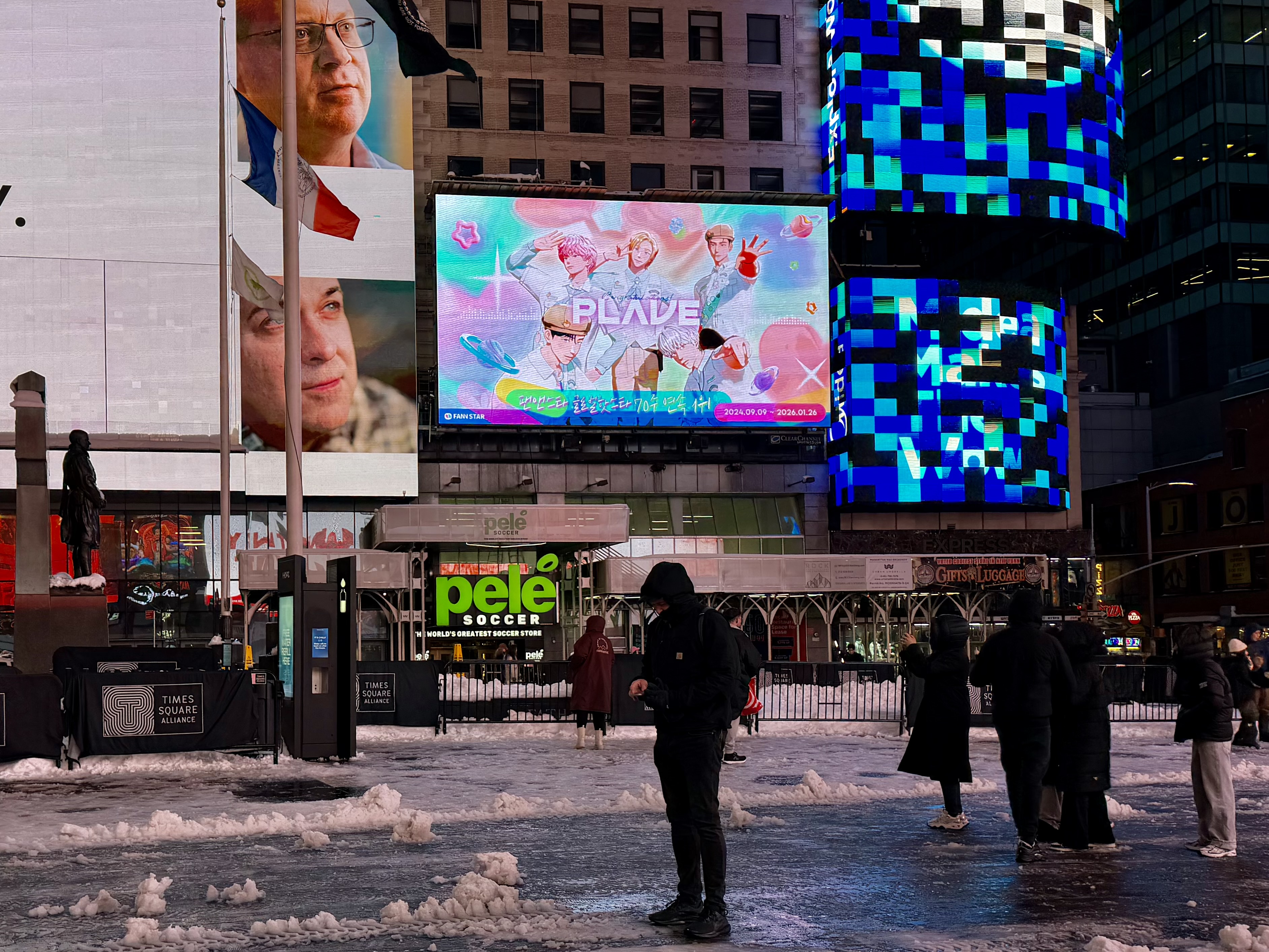
In the images, the PLAVE creative appears on a large LED screen positioned above Pelé Soccer in Times Square.
The location is listed at 1560 Broadway, placing the screen within one of the most visually dense parts of Times Square.
What makes this location particularly interesting is the environment surrounding the screen.
Immediately below is a large soccer retail store, while the surrounding streets are filled with major digital billboards, entertainment advertising, Broadway promotions, retail, and constant pedestrian movement.
The PLAVE screen therefore does not exist in isolation.
It becomes part of a much larger entertainment-driven urban landscape.
From an OOH strategy perspective, this can be interpreted as a choice that gives the fan campaign more than media exposure.
It places the artist within a globally recognizable cultural environment.
In other words:
The location itself becomes part of the message.
A Softer Creative in an Extremely Competitive Visual Environment
One of the most interesting elements of the campaign is its visual contrast with the surrounding Times Square screens.
The surrounding media environment is highly saturated with:
- Bright red and blue screens
- Large-scale typography
- High-contrast imagery
- Global entertainment advertising
- Constantly changing digital content
Against this environment, the PLAVE creative takes a different approach.
The screen is dominated by soft pink and sky-blue tones, illustrated characters, stars, planets, and playful graphic elements.
The large PLAVE logo sits at the center of the composition.
Rather than competing through visual intensity alone, the creative establishes its own visual identity through color, illustration, and character recognition.
This becomes especially noticeable in photographs taken from a distance.
Among the highly saturated screens of Times Square, the pastel-toned PLAVE creative creates a distinct visual island.
The Creative Reflects the Nature of Fandom Media
Another notable point is that the creative does not follow a traditional product-advertising structure.
There is no obvious emphasis on a product benefit or commercial CTA.
Instead, the focus is on the artists themselves and the PLAVE identity.
This is particularly relevant to fandom OOH.
The central message is less about:
“Buy this.”
and more about:
“The artist I support is here.”
The illustrated characters and space-themed visual elements also create a visual connection with PLAVE’s identity as a virtual K-POP group.
Rather than simply enlarging an artist image, the creative brings the artist’s visual world into a physical urban environment.
This can be interpreted as a form of IP-driven place branding — bringing an entertainment IP into one of the world's most recognizable public spaces.
The Real Expansion of OOH Happens After the Billboard
This may be the most important point for marketers.
The value of an OOH campaign should not always be measured only by:
“How many people saw it?”
For fandom-driven OOH, another question matters:
“How many people wanted to capture and share the moment?”
The potential journey looks like this:
OOH Exposure
→ On-site Photo
→ Social Upload
→ Fandom Sharing
→ Secondary Content
The physical billboard becomes the starting point for digital content.
This is particularly powerful in Times Square because the location itself is already highly photographable.
People naturally take photos of Times Square’s giant screens as part of their visit.
As a result, the advertising experience can become part of the visitor’s own content.
This is one of the distinctive strengths of OOH:
People do not simply see the advertisement. They can physically place themselves inside the scene.
The Location Itself Becomes Content
Look closely at the photographs.
Some images focus almost entirely on the PLAVE screen.
Others capture the billboard together with the surrounding Times Square landscape.
That difference is strategically significant.
When someone photographs only the screen, the content becomes:
“A PLAVE billboard.”
But when the surrounding Times Square environment appears in the frame, the story changes:
“PLAVE is in Times Square.”
The meaning of the advertisement expands from:
Media → Place → City
This is one of the most powerful characteristics of landmark OOH.
The symbolic value of the location can become part of the brand or IP experience.
For a global entertainment property, appearing in Times Square can therefore carry a meaning that goes beyond the physical size of the screen.
What Can Marketers Learn From This Case?
① In OOH, the location can become part of the content
The statement
“We advertised in Times Square.”
can itself become a story.
Therefore, global OOH planning should consider more than media metrics.
A useful question is:
“What does this location add to our brand story?”
② For fandom marketing, creating a memorable moment can matter as much as reach
Fandom audiences may engage with OOH differently from conventional consumers.
They may:
See → Photograph → Save → Share → Discuss
the campaign.
That means a key planning question can be:
“Is this a place where people will want to take a photo?”
For fandom-driven campaigns, the answer can be strategically important.
③ Global OOH is not only about reaching local consumers
Times Square brings together tourists, New Yorkers, commuters, office workers, theatergoers, and shoppers.
This diversity allows an OOH campaign to reach people who may have no prior connection to the artist or brand.
For global entertainment IPs, this creates an opportunity to introduce the brand through visual experience rather than language alone.
④ OOH and social media should not always be planned separately
Especially for entertainment and fandom marketing, the campaign journey can be designed as:
OOH → Photo → Social → Community
The key question is not simply whether the creative looks good on screen.
It is:
“Would people want to photograph this moment?”
That is a different creative challenge.
Conclusion
Times Square’s giant digital screens have long represented the ambition of global OOH.
But the PLAVE case shows that you do not necessarily have to be a global consumer brand to participate in that environment.
A fandom can also turn Times Square into a stage for an artist.
And once that happens, the billboard can become more than advertising.
For fans, it can become a keepsake.
For visitors, it can become something new they discover in New York.
And on social media, it can become a shareable moment.
Ultimately, the value of OOH is not determined only by how many people see a screen.
It can also be determined by what people experience because that screen exists in that particular place.
That is what makes the PLAVE Times Square case interesting.
Global OOH is not simply about making a screen bigger.
It is about placing a message in a location where the place itself can become part of the story.
A Global Stage Created by Fans — PLAVE in New York’s Times Square
Times Square has long been one of the world’s most recognizable OOH destinations, where global brands, entertainment properties, and cultural content compete for attention across massive digital screens.
But the PLAVE case offers a different perspective.
Here, the billboard is not simply a medium for delivering an advertising message. It becomes a stage created by fans for the artist they love.
Times Square Is More Than a Billboard — It Is a Global Stage
Times Square is one of Manhattan’s most prominent commercial and cultural districts, connecting entertainment, tourism, retail, transportation, and everyday urban life.
Its greatest OOH asset is the sheer scale and diversity of people moving through the area.
According to the Times Square Alliance, Times Square welcomed an average of approximately 220,000 pedestrian entries per day in 2024, reaching as many as 330,000 people on its busiest days.
The transportation network adds another layer of reach.
In 2024, the five subway stations serving the Times Square area recorded approximately 79.6 million annual passenger entries, while the Times Square–42nd Street station alone recorded approximately 57.7 million.
These numbers represent more than media exposure.
They demonstrate why Times Square functions as a city-scale media environment, where tourists, New Yorkers, commuters, office workers, shoppers, and theatergoers continuously intersect.
Why Is Times Square Particularly Attractive to Fandoms?
Fandom-driven OOH operates somewhat differently from conventional brand advertising.
For a brand, the primary objective may be awareness, consideration, or conversion.
For a fandom, the value can also lie in creating a memorable moment for the artist and the community around them.
That distinction makes Times Square particularly meaningful.
Seeing an artist appear on a billboard in one of the world's most iconic urban spaces can become an experience in itself:
“The artist I support is here, in Times Square.”
For fans, the billboard can therefore function not only as media, but also as a physical expression of support and celebration.
And because Times Square attracts such a diverse audience, that expression exists beyond the fandom itself.
A fan may see a familiar artist.
A tourist may simply discover a new piece of Korean pop culture.
A passerby may photograph the screen without knowing the artist.
That is where fandom OOH begins to expand beyond its original audience.
The Strategic Value of the Location — Above Pelé Soccer
In the images, the PLAVE creative appears on a large LED screen positioned above Pelé Soccer in Times Square.
The location is listed at 1560 Broadway, placing the screen within one of the most visually dense parts of Times Square.
What makes this location particularly interesting is the environment surrounding the screen.
Immediately below is a large soccer retail store, while the surrounding streets are filled with major digital billboards, entertainment advertising, Broadway promotions, retail, and constant pedestrian movement.
The PLAVE screen therefore does not exist in isolation.
It becomes part of a much larger entertainment-driven urban landscape.
From an OOH strategy perspective, this can be interpreted as a choice that gives the fan campaign more than media exposure.
It places the artist within a globally recognizable cultural environment.
In other words:
The location itself becomes part of the message.
A Softer Creative in an Extremely Competitive Visual Environment
One of the most interesting elements of the campaign is its visual contrast with the surrounding Times Square screens.
The surrounding media environment is highly saturated with:
- Bright red and blue screens
- Large-scale typography
- High-contrast imagery
- Global entertainment advertising
- Constantly changing digital content
Against this environment, the PLAVE creative takes a different approach.
The screen is dominated by soft pink and sky-blue tones, illustrated characters, stars, planets, and playful graphic elements.
The large PLAVE logo sits at the center of the composition.
Rather than competing through visual intensity alone, the creative establishes its own visual identity through color, illustration, and character recognition.
This becomes especially noticeable in photographs taken from a distance.
Among the highly saturated screens of Times Square, the pastel-toned PLAVE creative creates a distinct visual island.
The Creative Reflects the Nature of Fandom Media
Another notable point is that the creative does not follow a traditional product-advertising structure.
There is no obvious emphasis on a product benefit or commercial CTA.
Instead, the focus is on the artists themselves and the PLAVE identity.
This is particularly relevant to fandom OOH.
The central message is less about:
“Buy this.”
and more about:
“The artist I support is here.”
The illustrated characters and space-themed visual elements also create a visual connection with PLAVE’s identity as a virtual K-POP group.
Rather than simply enlarging an artist image, the creative brings the artist’s visual world into a physical urban environment.
This can be interpreted as a form of IP-driven place branding — bringing an entertainment IP into one of the world's most recognizable public spaces.
The Real Expansion of OOH Happens After the Billboard
This may be the most important point for marketers.
The value of an OOH campaign should not always be measured only by:
“How many people saw it?”
For fandom-driven OOH, another question matters:
“How many people wanted to capture and share the moment?”
The potential journey looks like this:
OOH Exposure
→ On-site Photo
→ Social Upload
→ Fandom Sharing
→ Secondary Content
The physical billboard becomes the starting point for digital content.
This is particularly powerful in Times Square because the location itself is already highly photographable.
People naturally take photos of Times Square’s giant screens as part of their visit.
As a result, the advertising experience can become part of the visitor’s own content.
This is one of the distinctive strengths of OOH:
People do not simply see the advertisement. They can physically place themselves inside the scene.
The Location Itself Becomes Content
Look closely at the photographs.
Some images focus almost entirely on the PLAVE screen.
Others capture the billboard together with the surrounding Times Square landscape.
That difference is strategically significant.
When someone photographs only the screen, the content becomes:
“A PLAVE billboard.”
But when the surrounding Times Square environment appears in the frame, the story changes:
“PLAVE is in Times Square.”
The meaning of the advertisement expands from:
Media → Place → City
This is one of the most powerful characteristics of landmark OOH.
The symbolic value of the location can become part of the brand or IP experience.
For a global entertainment property, appearing in Times Square can therefore carry a meaning that goes beyond the physical size of the screen.
What Can Marketers Learn From This Case?
① In OOH, the location can become part of the content
The statement
“We advertised in Times Square.”
can itself become a story.
Therefore, global OOH planning should consider more than media metrics.
A useful question is:
“What does this location add to our brand story?”
② For fandom marketing, creating a memorable moment can matter as much as reach
Fandom audiences may engage with OOH differently from conventional consumers.
They may:
See → Photograph → Save → Share → Discuss
the campaign.
That means a key planning question can be:
“Is this a place where people will want to take a photo?”
For fandom-driven campaigns, the answer can be strategically important.
③ Global OOH is not only about reaching local consumers
Times Square brings together tourists, New Yorkers, commuters, office workers, theatergoers, and shoppers.
This diversity allows an OOH campaign to reach people who may have no prior connection to the artist or brand.
For global entertainment IPs, this creates an opportunity to introduce the brand through visual experience rather than language alone.
④ OOH and social media should not always be planned separately
Especially for entertainment and fandom marketing, the campaign journey can be designed as:
OOH → Photo → Social → Community
The key question is not simply whether the creative looks good on screen.
It is:
“Would people want to photograph this moment?”
That is a different creative challenge.
Conclusion
Times Square’s giant digital screens have long represented the ambition of global OOH.
But the PLAVE case shows that you do not necessarily have to be a global consumer brand to participate in that environment.
A fandom can also turn Times Square into a stage for an artist.
And once that happens, the billboard can become more than advertising.
For fans, it can become a keepsake.
For visitors, it can become something new they discover in New York.
And on social media, it can become a shareable moment.
Ultimately, the value of OOH is not determined only by how many people see a screen.
It can also be determined by what people experience because that screen exists in that particular place.
That is what makes the PLAVE Times Square case interesting.
Global OOH is not simply about making a screen bigger.
It is about placing a message in a location where the place itself can become part of the story.